


Nigeria is home to some of the most profitable corporations on the African continent. Banks, telecoms, insurance firms, and manufacturing giants generate billions annually. Yet just a few kilometres from their headquarters, in places like Bariga, Makoko, Ebute Metta, and Ikota, families are making impossible choices every day between medicine and food, rent and meals, and survival and education.

The contrast is stark, but it is not irreversible. Even a small share of corporate profit can reshape these realities.
Imagine what just one percent of annual profit could achieve when directed through an organization like the Lagos Food Bank Initiative, which has spent a decade addressing hunger at scale. Since 2016, it has supported over 3.5 million households across more than 170 underserved communities in Lagos and 14 other states, through its strategic intervention programs.
The impact is measurable, and the need is constant.
Some corporations are already acting on this opportunity. The Glo Foundation, the CSR arm of Glo World, has partnered with the Lagos Food Bank Initiative to distribute food packs containing essential staples such as rice, garri, spaghetti, noodles, oil, and protein sources to families in communities like Bariga and Ikota. The Foundation selected the Food Bank for its proven track record and operational reach, with a goal of extending support into underserved and hard-to-reach areas across the country.
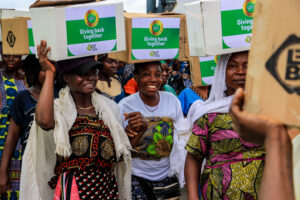
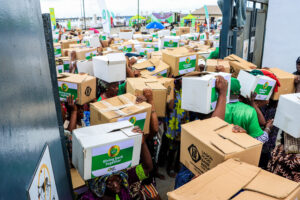
Cornerstone Insurance has also supported the Food Bank’s school feeding programme, providing nutritious meals to pupils in low-income schools, while staff volunteers joined in packing and distribution. Kuda has similarly continued its engagement through repeated food drives and employee volunteer programmes, including outreach in Makoko.
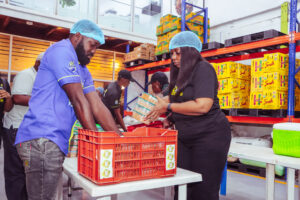
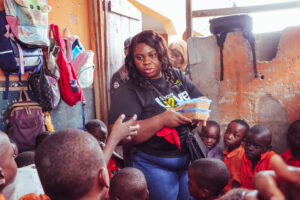
Across these partnerships, a consistent truth emerges: no single organization can solve hunger alone. Collaboration between the private sector and humanitarian actors is essential to sustaining impact at scale.
This is even more urgent in the current economic climate. Food inflation has pushed basic staples beyond the reach of millions, while rising healthcare costs force families to choose between treatment and survival. Government interventions, though important, cannot fully close the gap alone. Private sector participation is no longer optional, it is necessary.
The Lagos Food Bank Initiative invites corporations to consider a simple question: What could one percent of your profit do for families in underserved communities?
The answer, quite literally, is transformative.
Companies willing to explore partnership opportunities, whether through funding, employee volunteering, or long-term collaboration, are encouraged to engage the Lagos Food Bank Initiative. Because beyond profit lies something more lasting: the ability to change what survival looks like for millions of Nigerians.